Peacock vs. Ostrich vs. Pheasant Feathers: A Display Comparison
Walk into a room where feathers are on display and you will usually find three species doing the work: peacock, ostrich and pheasant. They could hardly be more different. One is architecture, one is atmosphere, one is detail. Deciding between them — or working out how to combine them — comes down to a handful of practical questions. How much height can the room take? How much light falls on the arrangement? How stable is the stand? And what do you want the display to do: impress from across the room, or reward a closer look?
The three varieties differ as much in posture as in scale. Peacock arcs. Ostrich falls. Pheasant points. Get that in your head and most of the styling decisions make themselves.
Peacock eyed feathers — the ones everyone recognises — commonly run somewhere between 80cm and a metre or more from the tip of the eye to the end of the quill. They are top-heavy, with a stiff quill that rises and then a broad, fan-shaped eye that carries real weight. Ostrich plumes are usually sold in lengths from roughly 40cm up to about 70cm for the large wing feathers. They have a flexible quill and soft, dense barbs with no stiff vane at all, so they drape and move. Pheasant tail feathers sit in the middle, often around 40–50cm on a cock bird, but they are narrow, tapered and pointed rather than wide or fluffy.
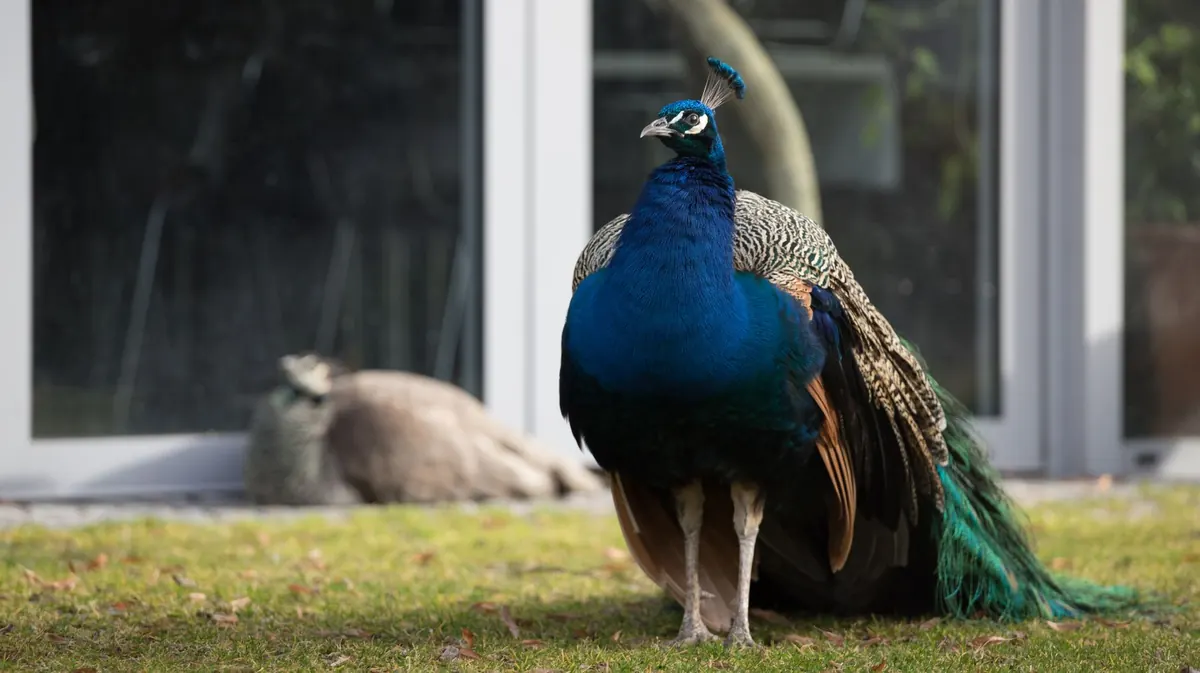
Nothing else in a display reads like a peacock eye. The quill is slim and firm, the herl along it is wispy, and then the eye opens out into bronze-green barbs with a blue-black centre and a fine gold rim. Because the colour is structural rather than pigment, it shifts with the angle you view it from. From the doorway it may look deep teal; two steps closer it turns green and gold. That quality is the reason peacock feathers hold a wall on their own.
The practical consequence is weight. A single eyed feather carries its mass at the top, and a small draught will turn it. For display, a floor stand with a wide, weighted base and a clip or ring that grips the quill just below the eye is the safest option. A fan arrangement — where several feathers share the load and splay outwards — works beautifully on a table or wall mount, but a narrow-necked vase will let a peacock feather lean, and once it leans it will pull the whole grouping with it.
Peacock iridescence is at its best in daylight or a well-placed lamp. Prolonged direct sun will dull the sheen over months, and dyed feathers of any kind fade faster, so keep the arrangement out of a south-facing window if you want it to last.
Ostrich is the opposite approach. There is no eye, no pattern, no sharp edge — just dense, silky barbs along a flexible quill that bends without snapping. Natural ostrich comes in charcoal grey, ivory, cream and warm tan; dyed versions run through the whole spectrum, and they take colour evenly because the barb structure is so fine.
Because the surface is matte, ostrich reads as mass rather than detail. Put a single plume in a slim vase and it disappears. Group eight or ten of them, though, and you get a soft cloud that fills a corner and moves gently when anyone walks past. Ostrich is the best of the three for hiding a gap, softening a hard shelf edge, or adding height to a room without adding visual noise.
For stands, give them room to splay. A wide-mouthed or trumpet vase with a grid, pin holder or loosely packed base lets the quills sit apart instead of bunching. Tall floor stands suit ostrich well if the quills are held individually at the base; the flexible stems will curve naturally outward and downward, which is exactly the effect you want. Trimmed tips give a neater, more formal look — untrimmed, slightly ragged tips give movement.
Pheasant feathers are the ones people lean in for. The long tail feathers carry clean horizontal barring in copper, russet and cream. The body feathers are shorter and rounded, and a cock bird's neck feathers show iridescent green, blue and purple that almost rivals peacock at close range. Hen feathers are quieter: buff, brown, finely speckled, and superb for texture.
Their stiffness and narrow shape make them ideal for precise work. They hold a line rather than droop, so they sit well in slim tubular vases, single-stem holders, small brass stands and table arrangements. They also mix naturally with dried grasses, seed heads and twigs, where a peacock or ostrich feather would overwhelm everything around it. The one rule: keep pheasant at or near eye level. High on a tall floor stand, the fine barring simply gets lost.
Before you buy a stand, run through these checks with the feathers in front of you:
The simplest structure that works: peacock as architecture at the back and centre, set tallest and given the most space. Ostrich as atmosphere, grouped lower and slightly to one side, filling the volume between the peacock quills and the surface. Pheasant at the front, at eye level, where the pattern can be seen. Keep the count of pheasant stems small — three to five is usually enough to hold a corner of the arrangement.
Colour is where mixed displays go wrong. A natural palette of bronze, charcoal, cream and russet will always sit comfortably together. Add one dyed plume in a strong colour only if you want it to be the focal point, and place it where it will be seen against a plain background rather than against the busy barring of a pheasant tail.
Measure the space, then measure the feathers. Check that the base will not tip when the tallest plume is in place, and that the holder grips the quill without marking it. If you are storing spares, keep them flat in a box lined with acid-free tissue, away from damp and in a consistent temperature — quills warp in fluctuating conditions and there is no way to straighten them reliably afterwards. Dust on display with cool air from a hairdryer on its lowest setting, held well back, rather than a cloth, which will drag the barbs apart.
Buy one variety first, get the stand right, and live with it for a week before adding the next. Feathers are forgiving material, but they are not patient with a stand that cannot hold them.
Photo: Mateusz Feliksik / Pexels
Previous Post
How to Clean and Maintain Acrylic and Wooden Display Stands
Next Post
Small Space, Big Impact: Feather Display Ideas for Flats